



Black Specks in Hot Water? How to Tell If It Is the Anode Rod, Hoses, or Tank
Black specks that show up only in hot water point to the water heater side of your plumbing, because that is the only place hot water gets made. Soft flakes that smear like grease usually mean degraded rubber, hard gritty flecks usually mean sediment, and gel-like beads usually mean the anode rod. Waldman Plumbing and Heating, a fourth-generation family company in Lynn since 1920, is BBB accredited and carries verified reviews on Google, Yelp, and HomeAdvisor. Our plumbers work under MA Master Plumber License #12964, carry General Liability and Workers Compensation insurance, and answer emergency calls 24/7.
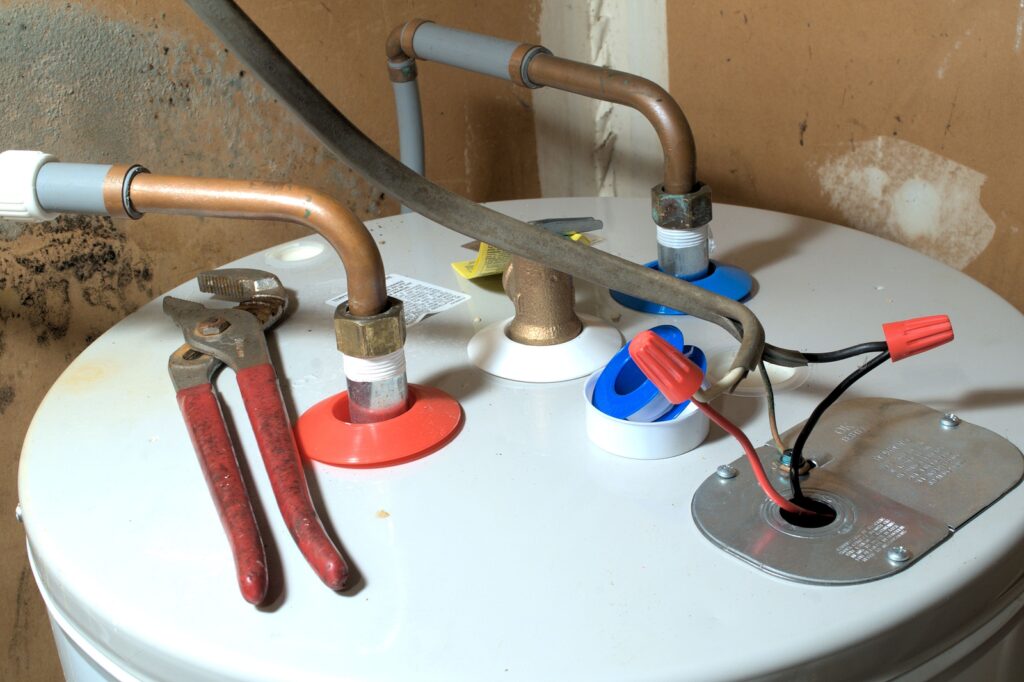
If the specks come out of every tap, hot and cold, start with our broader guide to black specks in tap water. This guide covers specks that arrive with hot water, and it works for tank-type and tankless units alike. A tankless water heater has no storage tank or anode rod, so the connectors, inlet screens, and fixtures become the suspects.
What Black Specks in Hot Water Are and Why the Material Matters
A tank water heater stores heated water in a steel tank. A sacrificial anode rod inside the tank protects the steel, and A. O. Smith explains that these rods come in aluminum, magnesium, or zinc. Hot water leaves the tank through a flexible or rigid connector, and in many homes it passes an expansion tank that absorbs pressure.
Each part sheds a different kind of material when it fails. Rubber leaves soft black flakes, an anode rod can leave a gel, and a corroding tank leaves rust. Because the material differs, the specks themselves are your best clue. Use this table as a first read:
| What You See | What It Usually Means | Where It Comes From |
| Soft black flakes that smear like grease or leave a pencil-like mark | Degraded rubber | A flexible hose or connector lining, or an expansion tank diaphragm |
| Black particles that appear as the water heats, then clear | Rubber from the heater connection | The water heater flex connector |
| Gray, green, or blue gel-like beads in aerators or at the tank drain | Aluminum hydroxide from an aluminum anode in high-pH water | The anode rod, often in a newer water heater |
| Hard, gritty dark flecks that do not smear | Sediment or scale | The bottom of the tank, or aging pipes |
| Brown or orange hot water | Rust, possibly a tank that has started to corrode | The tank, often after the anode rod is used up |
| Dark, cloudy water or black staining on fixtures in hot and cold | Manganese | The water supply or a private well |
7 Sources of Black Specks in Hot Water
1. Degraded Rubber Lining in Flexible Hoses and Connectors
Flexible connectors link the water heater to the plumbing, and many have a rubber or elastomer lining inside a braided stainless sleeve. Stanford University’s Utilities Division explains, in a fact sheet for faculty and staff housing residents, that chloramine disinfectants can cause the rubber or elastomer linings in certain older parts to break down and release soft, black flakes. The flakes typically show up at the first draw from a tap and then clear, and they may look greasy and smear on surfaces. For a water heater flex connector, the fact sheet says black particles appear as the water heats and then clear as the hot water pushes them out.
The City of Ann Arbor says that chloramines are not compatible with some types of rubber and will cause them to dissolve. A utility fact sheet on black specks adds that the particles smear and leave a pencil-like mark on your fingers. The fix is a chloramine-resistant replacement. Stanford lists parts made of silicone-based rubber or synthetic polymers, or copper or nylon flex lines, and advises looking for products labeled chloramine resistant.
2. A Worn Expansion Tank Diaphragm
A thermal expansion tank has a rubber diaphragm inside it. The same utility fact sheet lists a worn membrane, a diaphragm that degrades over time, as a source of black specks, and it recommends replacing the tank with one that resists chloramines. Our guide to installing a thermal expansion tank explains what the tank does for the water heater.
3. The Anode Rod
The anode rod is the part most people suspect, and it is the one a homeowner cannot inspect without a plumber. A. O. Smith recommends inspecting the rod once a year and says how long it lasts depends on the chemicals in the water, how much hot water the household uses, and whether the home has a water softener. Bosch describes the rod as sacrificial and made of aluminum, magnesium, or both.
The anode can also leave a residue. State Water Heaters Technical Bulletin 14 explains that water with a pH of 8 or higher can react with an aluminum anode and form excess aluminum hydroxide. The bulletin covers new water heaters, installed less than six months, and describes the residue as jelly beads or a green, blue, or gray gel that can appear at the tank drain or in faucet aerators. Its fix is to replace the aluminum anode with a magnesium anode. This residue is easy to mistake for specks, which is why the texture test below matters.
4. Sediment and Scale in the Tank
Sediment settles at the bottom of a tank, and it can reach the taps when it is stirred up. Our broader specks article lists it too. Hard, gritty flecks that do not smear are the usual sign. Our guide on preventing scale buildup in your water heater explains how scale forms and what slows it.
5. A Corroding Tank
When the anode rod runs out, the steel tank begins to corrode. Bosch warns that brown or orange hot water can mean the rod has run out and the tank is starting to rust, and that at that point it may be too late to simply replace the rod. Rust flakes and rust-colored water point to the tank itself. Our articles on rust-colored water and on what to do when your hot water heater leaks cover the next steps.
6. Manganese or Iron in the Water
MassDEP’s consumer fact sheet on manganese says manganese above 0.05 mg/L can cause staining of fixtures and dark, cloudy water. Manganese reaches both hot and cold taps, so it shows up on the cold side too. Public water customers can ask their water system about it. Private well owners should test a baseline sample through a MassDEP-certified laboratory.
7. Treatment Equipment, Fixtures, and Supply Disturbances
Water treatment equipment and fixtures shed material too. Activated carbon filter media can break down, and rubber or plastic washers and gaskets can degrade. If the specks began after a new filter or a service visit, check that equipment first. Our water filtration service covers filter and media service. Street work matters as well. MWRA’s FAQ notes that flow changes from water main breaks or hydrant use can stir up rust, and that the effect is temporary and typically clears within a couple of hours.
Warning Signs That Point to Each Source
- Soft flakes that smear, mostly at the first draw: rubber from a connector or the expansion tank.
- Gel-like beads in aerators or at the tank drain: an anode reaction.
- Brown or orange hot water, or rust flakes: a tank that may have started to corrode.
- Moisture, drips, or rust stains at the base of the tank, the connectors, or the expansion tank: a leak that needs prompt attention from a licensed plumber.
- Specks that return after you clean the aerators: the source is still shedding.
- Dark cloudy water or black staining on fixtures in hot and cold: manganese, or another supply issue.
- Specks that began after a new filter, softener service, or street work: treatment media or a supply disturbance.
DIY Checks vs. Calling a Licensed Plumber
A Seven-Step Home Test
- Run each tap for about a minute, then fill one clear glass from the cold tap and one from the hot tap. Specks in the hot glass only point to the water heater side. Specks in both point to the supply side.
- Pour the water through a white coffee filter or a paper towel to catch the specks and see their color and size.
- Rub a few specks between your fingers. Soft and greasy points to rubber. Hard and gritty points to sediment. Gel-like beads in gray, green, or blue point to the anode.
- Unscrew a faucet aerator and a showerhead and look for trapped debris. Rubber flecks and gel beads both collect there.
- Look at the flexible connectors on the water heater. Check for cracks, bulges, or stains, and do not disconnect anything.
- Note the timing. Particles that appear as the water heats and then clear match the pattern Stanford describes for a heater flex connector.
- Note the service date of any softener or filter, and schedule a MassDEP-certified lab test if you use a private well.
Leave These to a Licensed Plumber
- Anode rod inspection, replacement, or a swap to a different anode type.
- Replacement of flex connectors and the expansion tank.
- Tank draining and flushing, which involves hot water, pressure, and the gas or electric supply.
- Tank condition checks when the water runs brown or orange.
- Softener, filter, and well-treatment service.
Solutions: How a Plumber Fixes Each Source
| Source | Professional Fix | What Prevents a Repeat |
| Flex connector lining | Replace with chloramine-resistant or copper connectors | Check connectors at each water heater service |
| Expansion tank diaphragm | Replace the tank with a chloramine-resistant model | Include the expansion tank in the annual water heater check |
| Anode rod | Inspect, replace, or swap an aluminum rod for magnesium where high-pH water forms gel | Annual anode inspection, as A. O. Smith recommends |
| Tank sediment | Flush the tank as the manufacturer directs and check its condition | Regular flushing and scale control |
| Corroding tank | Replace the water heater when the tank is failing | Anode care before the rod is used up |
| Manganese or iron | Test through a certified lab, then choose treatment such as a cation-exchange softener or reverse osmosis | Retest on the schedule MassDEP recommends |
| Filters, softener, fixtures | Service or replace media, clean aerators, and replace worn washers and gaskets | Service on the manufacturer schedule |
Anode Rod Swap or New Water Heater?
| Option | Pros | Cons |
| Replace the anode rod | A smaller job when the tank is still sound; restores the sacrificial protection that guards the steel | Does not help once the tank has started to rust, and Bosch warns it may be too late by then |
| Replace the water heater | Resets the tank, connectors, and expansion tank at once; new equipment carries a manufacturer warranty | Larger project that needs planning around your hot water needs |
A plumbing inspection is a good way to check the water heater, connectors, expansion tank, and supply piping together. Our water heater service team handles repair and replacement, and our tank water heater expert explains the options when replacement makes sense.
Black Specks in Hot Water Across Lynn, Boston, Newton, and the North Shore
Local water chemistry matters here. MWRA says in its FAQ that it uses a mild disinfectant called monochloramine, that its water is soft at approximately 16 milligrams per liter, or 1 grain per gallon, and that you do not need a water softener. MWRA’s water and health says it adjusts Metro Boston water to a pH of 9.0 to 9.5 in the distribution system to prevent corrosion and reduce the release of lead from service lines and home plumbing, and it reports a 2025 Metro Boston average of 9.6.
Those two facts connect to the causes above. Other utilities link chloramine to rubber breakdown, and State’s bulletin names a pH of 8 or higher as the trigger for anode gel, so both causes are plausible in homes that MWRA serves. MWRA’s FAQ does not discuss rubber parts or anode rods, so a plumber should confirm either cause by inspecting the parts in your home.
Not every home gets MWRA water. MWRA’s list of water communities includes Boston, Newton, Swampscott, Marblehead, Nahant, Saugus, Reading, Revere, and Winthrop, and names Peabody, Wakefield, Winchester, and Woburn among the partially supplied communities. Lynn, Salem, and Beverly do not appear on the list, so homes there should read their own water department’s annual report and ask about the disinfectant and pH.
Private wells put the testing responsibility on the homeowner. MassDEP’s private well guidance strongly urges homeowners to test well water at least once a year and recommends a MassDEP-certified laboratory. Housing age adds another layer. U.S. Census Bureau American Community Survey estimates put the median home in Lynn at 1946 construction and the median home in Newton at 1942, and aging connections between old pipe types can shed particles of their own, as our article on why copper-galvanized pipe connections fail explains.
We service water heaters in Lynn, Swampscott, Marblehead, and Newton and Boston through our Newton water heater service and Boston water heater service.
Frequently Asked Questions About Black Specks in Hot Water
Why do I only see black specks in my hot water?
Hot-only specks point to the water heater side of the plumbing, since that is the only place hot water gets made. The usual sources are the rubber lining of a flexible connector, the diaphragm in an expansion tank, the anode rod, and sediment or rust inside the tank. A plumber can tell which one by looking at the specks and the parts.
What do rubber flakes from a worn hose or connector look like?
Stanford University’s Utilities Division describes soft, black flakes that can look greasy and smear on surfaces, and a utility fact sheet says the particles leave a pencil-like mark on your fingers. The flakes often show up at the first draw from a tap and then clear.
Can chloramine damage rubber plumbing parts?
Yes. The City of Ann Arbor says chloramines are not compatible with some types of rubber and will cause them to dissolve, and Stanford’s Utilities Division says chloramine disinfectants can break down rubber or elastomer linings in certain older parts. Parts labeled chloramine-resistant or chloramine-compatible resist this damage.
Does MWRA water cause black specks?
MWRA says it treats its water with a mild disinfectant called monochloramine. Other utilities that use chloramine report that it can break down some rubber parts, but MWRA’s FAQ does not discuss rubber parts, so a plumber should confirm any link by inspecting the connectors, expansion tank, and fixtures in your home.
Can an expansion tank cause black specks in hot water?
Yes. A utility fact sheet lists a worn membrane in the water heater’s thermal expansion tank, a rubber diaphragm that degrades over time, as one source of black specks. The fix is to replace the tank with one that resists chloramines.
Can the anode rod cause black specks?
The anode rod is a sacrificial rod that protects the tank, and A. O. Smith recommends inspecting it once a year. State Water Heaters Technical Bulletin 14 describes the anode-related residue as jelly beads or a green, blue, or gray gel, formed when water at pH 8 or higher reacts with an aluminum anode. Its fix is a magnesium anode. A plumber can check which type you have.
How often should the anode rod be checked or replaced?
A. O. Smith recommends inspecting the anode rod once a year and says its life depends on the chemicals in the water, how much hot water the household uses, and whether the home has a water softener. Replacement timing varies by brand and water, so ask a plumber to judge the rod’s condition rather than following a fixed calendar.
What does brown or orange hot water mean?
Bosch warns that brown or orange hot water can mean the anode rod has run out and the tank is starting to rust, and that it may be too late to simply replace the rod at that point. Have a plumber inspect the tank soon.
Could black specks be sediment from the tank?
Yes. Sediment settles at the bottom of the tank and can reach the taps when it is stirred up. Sediment tends to feel hard and gritty and does not smear. Flush the tank as the manufacturer’s instructions describe, and have a plumber check the tank’s condition.
Can manganese cause black specks or staining?
MassDEP says manganese above 0.05 mg/L can cause staining of fixtures and dark, cloudy water. Public water customers can ask their water system about manganese, and private well owners should test through a MassDEP-certified laboratory.
How often should a private well be tested?
MassDEP strongly urges homeowners to have well water tested at least once a year, whether or not the local Board of Health requires it, and recommends a MassDEP-certified laboratory. Ask the lab which parameters to include, since iron and manganese have no specified tests but MassDEP still recommends a lab certified in other drinking water parameters.
How can I tell where the specks come from at home?
Fill one clear glass from the hot tap and one from the cold tap, strain the specks through a white coffee filter, and rub a few between your fingers. Hot-only specks point to the water heater side, and specks in both point to the supply side. Soft, greasy smears point to rubber, hard grit points to sediment, and gel beads point to the anode. Check the aerators too, and write down what you find for your plumber.
Why do the specks come back after I clean the aerators?
Aerators only catch the debris. The source keeps shedding until a plumber replaces the failing part, such as the connector lining or the expansion tank, or fixes the tank or the treatment equipment.
Do tankless water heaters get black specks too?
A tankless unit has no storage tank or anode rod, so the connectors, inlet screens, filters, and fixtures become the suspects. The same rubber-lining and treatment-equipment causes apply.
What does Waldman do when you call about black specks in hot water?
A licensed plumber compares hot and cold water, inspects the flexible connectors, expansion tank, anode rod, and tank, checks any filter or softener, and then repairs or replaces the part that is shedding. Our trucks are stocked with replacement parts so we can complete most repairs during our first visit. Call 781.780.3184 any time, day or night, for 24/7 service.
When to Call Waldman Plumbing and Heating
Waldman Plumbing and Heating has served Lynn, the North Shore, and Greater Boston for over 100 years. Our licensed plumbers trace the source instead of guessing: hot and cold comparison, connectors, expansion tank, anode rod, tank condition, and any filter or softener. We service Rinnai, Navien, Bradford White, Rheem, A. O. Smith, Bosch, and State water heaters. Call us when specks return after you clean the aerators, when the hot water runs brown or orange, or when you see moisture at the tank or connectors.
| What We Offer | What It Means for You |
| Licensed Master and Journeyman Plumbers | MA Master Plumber License #12964. Every plumber on our team is licensed under 248 CMR 10.00 and verified through the Massachusetts Board of State Examiners of Plumbers and Gas Fitters. |
| Fully Insured: General Liability and Workers Compensation | Zero liability comes back to you during water heater diagnosis and repair in your North Shore property. |
| BBB Accredited, A+ Rating | Third-party verified trust record across 100+ years. View our BBB accreditation profile. |
| Verified Customer Reviews | See what North Shore and North Shore neighbors say on Google, Yelp, and HomeAdvisor, or read verified customer testimonials. |
| Leading Brands: Rinnai, Navien, Bradford White, Rheem, AO Smith, Bosch | We install the professional-grade equipment brands that deliver the best long-term value for local homeowners. |
| Over 100 Years, Four Generations | Family-owned since 1920 and now in its fourth generation. Read our company story to see who will be working in your North Shore property. |
| 24/7 Emergency Service | Urgent problems do not wait for business hours. We respond any time, any day. |
| 1 to 5 Year Warranties on Labor and Parts | Written warranties back the work we perform and the materials we install. |
| Annual Inspection via Ultimate Savings Club | The Ultimate Savings Club membership adds an annual system inspection with digital carbon monoxide analysis, member repair savings, and front-of-line scheduling. |
| Financing Available via GreenSky | Qualified customers can spread larger projects over time. Apply for plumbing financing. |
| PHCC Member | Active membership in the Plumbing-Heating-Cooling Contractors Association keeps our team current on industry standards. |
Read verified customer reviews and check our credentials: Google Reviews | Yelp Reviews | HomeAdvisor Profile | BBB Accreditation Profile | Facebook Reviews
Get the Black Specks Out of Your Hot Water
Call Waldman Plumbing and Heating at 781.780.3184 for same-day and 24/7 emergency water heater service. Our licensed, insured, BBB-accredited plumbers hold MA Master Plumber License #12964, and we back our work with 1 to 5 year warranties on labor and parts.