



Heat Pump or Mini-Split Iced Over? What Is Normal Defrost and What Is Not
A thin layer of frost on the outdoor coil, a brief defrost cycle, and a cloud of steam rising from the unit are normal for a heat pump or ductless mini-split in winter. Ice that thickens, covers the unit, or keeps coming back after the defrost cycle is not normal. Waldman Plumbing and Heating, a fourth-generation family company in Lynn since 1920, is BBB accredited and carries verified reviews on Google, Yelp, and HomeAdvisor. Our licensed heating team holds MA Master Plumber License #12964 and MA Sheet Metal Worker License #830, carries General Liability and Workers Compensation insurance, and answers calls 24/7.
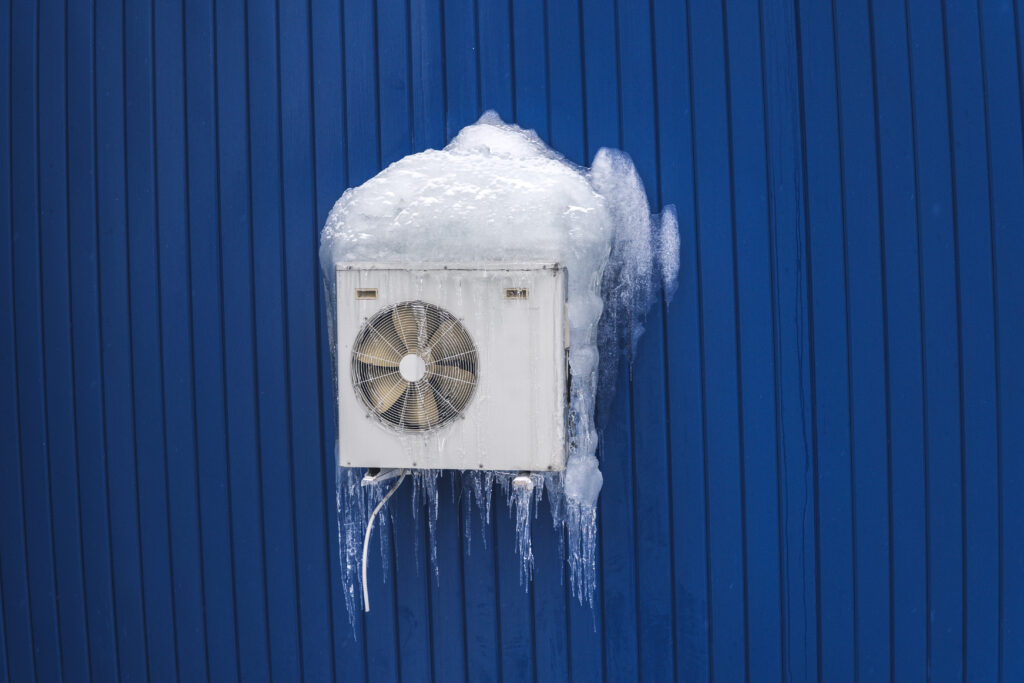
This guide covers air-source heat pumps and ductless mini-splits, which share the same defrost logic. Our heating services include heat pump and mini-split installation, repair, and maintenance. Ducted systems can run backup heat strips during defrost, while some ductless units pause the indoor fan, so the indoor signs differ slightly. The outdoor unit behaves the same way in both.
What Defrost Is and Why the Outdoor Unit Frosts Up
In winter, a heat pump pulls heat from outdoor air and moves it indoors. To do that, the outdoor coil has to run colder than the air around it. Trane puts that gap at 10 to 20°F, so frost can form even when the outdoor temperature is in the low 40s, though it is more common in the 20s and 30s. Green Building Advisor’s Allison Bailes explains the physics: moisture in the air condenses or freezes on the colder coil.
A frosted coil moves less air and heats less efficiently, so the system melts the frost on its own. Defrost works by switching from heating mode to cooling mode, which sends heat from indoors to the outdoor coil, and the outdoor fan stops so more of that heat goes into the frost. Lennox says most systems check for frost every 30 to 90 minutes during heating mode. Trane describes demand-defrost models that use sensors and defrost only when needed.
That sequence explains most of what homeowners notice: steam from the outdoor unit, a whooshing sound, a paused outdoor fan, a slight dip in indoor warmth, and AUX on the thermostat. Compare what you see with this table:
| What You See or Hear | Usually Normal | Worth a Service Call |
| Frost on the outdoor coil | A light layer on a cold, damp day that clears during defrost | Ice that thickens, covers the unit, or returns soon after thawing |
| Steam or vapor from the outdoor unit | A cloud that rises while frost melts, then stops | No defrost cycle at all after several hours of running while ice builds |
| Defrost timing | A frost check every 30 to 90 minutes, with a cycle of a few minutes up to about 15 | Constant switching into defrost, or cycles that keep getting longer |
| Sounds | A whoosh as the system changes modes, and a pause in the outdoor fan | Grinding, squealing, or banging, or a fan that does not spin after the ice melts |
| Indoors | A brief dip in warmth, AUX on the thermostat, or a paused indoor blower | Rooms that stay cool, weak airflow, or a system that runs longer than usual |
| Ice pattern | Even, light frost across the coil | Ice on one side only, an unusual pattern, or ice on the refrigerant lines |
7 Causes of a Heat Pump or Mini-Split That Ices Over
1. Cold, Damp Weather
ACHR News notes that heat pumps normally gather much more ice in very humid weather, and Lennox lists prolonged freezing rain, sleet, heavy wet snow, and high humidity with very cold temperatures among the causes of excess ice. A healthy system clears this ice through defrost. Extreme weather can overwhelm even a healthy unit for a few hours, which is why Lennox suggests calling a technician if the ice has not melted within 6 to 8 hours.
2. Blocked Airflow Around the Outdoor Unit
Leaves, debris, drifting snow, shrubs, or stored items around the outdoor unit starve the coil of air. Both Lennox and Canary Media advise leaving at least two feet of clearance around the unit. Canary Media also advises raising the unit off the ground where snow or leaves are common, so meltwater can drain during defrost instead of refreezing.
3. Dirty Filters and Restricted Indoor Airflow
Lennox lists dirty or clogged indoor air filters, collapsed or blocked ductwork, and closed or blocked supply vents as airflow problems that lead to excess ice. Canary Media observes that tons of homeowners never change their filters. On a ductless mini-split, the indoor unit’s filters and coil play the same role, and your manual shows how to clean them.
4. A Defrost Control, Timer, or Sensor Problem
The defrost control board, timer, and sensors tell the system when to start and stop defrosting. ACHR News describes a service call where a forced defrost ended after only about 30 seconds, which the author called a sign that the defrost cycle was not functioning correctly. A replacement defrost control board fixed it. A sensor that reads wrong can also end defrost too early and leave ice behind.
5. Low Refrigerant Charge
ACHR News explains that with low refrigerant, there may not be enough refrigerant for the defrost cycle to be fully effective, so ice builds up cycle after cycle. A system does not use up refrigerant, so a low charge points to a leak. Heating output drops along with it. This one is not a homeowner repair, because EPA requires certification for technicians who maintain, service, repair, or dispose of equipment that could release refrigerants.
6. Drainage Problems
Melted frost has to leave the unit. Lennox lists a clogged drain pan or drain line as a cause of icing, because water pools and refreezes. Green Building Advisor adds that meltwater can refreeze beneath the outdoor unit, and that enough ice can leave the unit unable to drain properly.
7. Failed Components: Reversing Valve or Outdoor Fan Motor
The reversing valve switches the system between heating and cooling modes, so a valve that sticks can stop defrost from working at all. Lennox also lists a failed outdoor fan motor and a faulty control board. These repairs need a licensed technician with the right tools.
Warning Signs That the Icing Is a Problem
- The unit keeps switching into defrost, or the cycles get longer. Trane lists both as reasons to call a local dealer.
- Ice that has not melted within 6 to 8 hours, or that refreezes quickly after thawing. Lennox lists both.
- Ice on the refrigerant lines, or on only one side of the unit. Lennox lists both, along with unusual ice patterns, as reasons to call a dealer.
- An outdoor fan that does not spin after the ice melts, or grinding, squealing, or banging. These can point to a failing motor or another mechanical fault.
- Weak airflow, rooms that stay cool, or a system that short cycles or runs longer than usual.
- Energy use that climbs without explanation. A frosted coil makes the system work harder for less heat.
- A hiss or reduced heating output. These can signal a refrigerant leak.
- No defrost cycle at all after several hours of running while ice builds. That points to the control or sensor side.
DIY Steps vs. Calling a Licensed Professional
Safe Steps While You Wait for Service
- Check the thermostat mode against your manual. Lennox advises setting the thermostat to off so the unit can thaw, and its FAQ also notes that the emergency heat setting lets the outdoor unit thaw while the home stays warm. Follow the instructions for your model. If a smart thermostat is involved, our article on how small thermostat errors create big heating inefficiencies covers common settings mistakes.
- Clear at least two feet of space around the outdoor unit, and gently brush light snow off the top with a broom.
- Check the indoor air filter and replace it if it is dirty. On a mini-split, clean the indoor filters as your manual directs.
- Make sure the supply vents and return grilles are open and unblocked.
- Let the ice thaw on its own. Lennox says a frozen unit takes about 2 to 4 hours to thaw above freezing, and longer in colder weather.
- Note the ice pattern, how long the fan stays off, and any noises. Photos help the technician.
- Call a licensed technician if the ice is still there after 6 to 8 hours, or if it refreezes quickly.
What Not to Do
- Do not pour hot water on the unit. Lennox warns that the sudden temperature change can crack components, and Canary Media gives the same warning about the metal.
- Do not chip at the ice with tools or sharp objects. Lennox warns that chipping can damage the coils, fins, and fan blades. Canary Media adds that a misplaced stab can cause a refrigerant leak.
- Do not use a heat gun or other high-heat source. Lennox lists high-heat sources among the things to avoid.
- Do not open the unit or handle refrigerant. Leave sealed-system work to a certified technician.
Leave These to a Licensed Professional
- Refrigerant leak testing, repair, and recharge.
- Defrost control board, timer, and sensor testing and replacement.
- Repair of the reversing valve and the outdoor fan motor.
- Coil cleaning, drain line and drain pan service, and ductwork repair.
- Electrical diagnosis on the outdoor and indoor units.
Solutions: How a Technician Fixes Each Cause
| Cause | Professional Fix | What Prevents a Repeat |
| Cold, damp weather | Confirm the defrost cycle runs and clears the ice, then check the settings and sensors | A pre-season defrost test |
| Blocked outdoor airflow | Clear the area, trim back growth, and recommend a raised pad or bracket if drainage is poor | Two feet of clearance and a snow check after storms |
| Dirty filters or restricted airflow | Replace filters, clean coils, and correct blocked vents or ductwork | Filter care on the schedule in your manual |
| Defrost control or sensor fault | Test the board, timer, and sensors, then replace the failed part | Annual testing of defrost operation |
| Low refrigerant | Find the leak, repair it, and restore the correct charge | Early service when heating output drops |
| Drainage problem | Clear the pan and drain line and correct the pitch or pad height | A drainage check at each tune-up |
| Failed reversing valve or fan motor | Diagnose and replace the part, then verify defrost and heating modes | Attention to new noises and fan behavior |
A thorough pre-season tune-up checks airflow, coils, drains, and defrost operation before the first cold, damp week. Our heating maintenance service is the way to book that kind of preventive check, and our article on efficiency losses that only a professional heating inspection can catch shows what a trained eye finds that a homeowner misses.
Repair or Replace?
| Option | Pros | Cons |
| Repair | Fixes the failed part, such as a sensor, board, fan motor, or drain; keeps the existing equipment and its layout | Repeat failures are more likely on older units, and a refrigerant leak can return if the source is not found |
| Replace | New equipment with a manufacturer warranty; cold-climate models carry certified low-temperature performance | Larger project that needs sizing and a review of the home and its existing heat |
Heat Pump and Mini-Split Icing on the North Shore and in Greater Boston
Our coastline sits squarely in the temperature range where coils frost often. NOAA’s State Climate Summary for Massachusetts reports that winter low temperatures range from near 30°F along the coast to less than 20°F in the west. Trane notes that frost is more common when outdoor temperatures sit in the 20s and 30s, so units in Lynn, Swampscott, Marblehead, Newton, and Boston regularly operate in the frost range. The same NOAA summary records that Boston Logan reached -10°F on February 4, 2023, the site’s first negative double-digit temperature since 1957. Rare cold like that is why the rated low-temperature performance of your model matters.
Damp weather adds to it. NOAA’s winter outlook, released October 15, 2026, favors warmer-than-average temperatures for much of the East and wetter-than-average conditions along the East Coast. Lennox says cold, damp days bring more defrost cycles, while dry or sunny days bring few or none. A wetter winter can mean more cycles and more steam, and that alone is normal.
Cold-climate equipment suits this region. Green Newton’s heat pump FAQ says cold-climate air-source heat pumps are certified based on their performance at 5°F and can extract heat from the air down to at least -13°F. About 20.5 percent of Massachusetts households heat with electricity, according to Mass.gov’s summary of Census data, a group that includes heat pumps and electric resistance heat. Mass Save, led by six Massachusetts energy providers including Eversource and National Grid, lists current heat pump programs for residents.
Older housing shapes the setups here. U.S. Census Bureau American Community Survey estimates put the median home in Lynn at 1946 construction and the median home in Newton at 1942. Older homes often have an existing boiler or furnace, and a heat pump or mini-split can work beside it. We service heat pumps, mini-splits, and the heating equipment beside them in Lynn, Swampscott, Marblehead, Newton, and Boston, where our Boston heating maintenance team covers the same seasonal checks.
Frequently Asked Questions About Iced-Over Heat Pumps and Mini-Splits
Is it normal for a heat pump to ice up in winter?
Some frost is normal. Lennox says to expect a light layer of frost on the outdoor coils, especially in cold, humid weather, and the defrost cycle exists to melt it. Ice that thickens, covers the whole unit, or returns quickly after defrost is not normal and needs a technician.
How often does a heat pump go into defrost mode?
It depends on the system and the weather. Lennox says most systems check for frost every 30 to 90 minutes during heating mode, and that cold, damp days bring more cycles while dry or sunny days bring few or none. Trane describes demand-defrost models that use sensors and defrost only when needed.
How long should a defrost cycle last?
Manufacturers give a short range. Trane describes cycles of 3 to 5 minutes that end as soon as the ice clears, and Lennox describes 5 to 15 minutes. Have a professional check a cycle that runs much longer, or cycles that keep getting longer.
Why is steam rising from my outdoor unit?
Steam during defrost is normal. Trane calls it perfectly normal, since it is melting ice evaporating, and Lennox describes it as water vapor. Steam alongside ice that never clears, or alongside grinding or banging noises, is a reason to call.
Why does my mini-split or heat pump blow cool air or stop blowing during defrost?
During defrost the system briefly switches into cooling mode to melt the frost. Ducted systems often turn on backup heat, shown as AUX on many thermostats, to limit the dip. Some units without backup heat pause the indoor blower or send out cooler air for a short time. A brief pause is normal, but rooms that stay cool, or cool air that keeps returning, need a technician.
What should I do if ice covers my heat pump?
Check the thermostat mode against your manual, keep at least two feet of clear space around the outdoor unit, replace a dirty indoor filter, and gently brush light snow off the top with a broom. Then let the ice thaw on its own. Lennox says a frozen unit takes about 2 to 4 hours to thaw above freezing and longer in colder weather. If the ice has not melted in 6 to 8 hours, or it refreezes quickly, call a licensed technician.
Can I pour hot water on a frozen heat pump or chip the ice off?
No. Lennox warns that hot water can crack components through sudden temperature change, and that chipping ice with tools can damage the coils, fins, and fan blades. Canary Media adds that a misplaced stab with a sharp object can cause a refrigerant leak. Let the unit thaw, and call a technician if it does not.
Should I use emergency heat when my heat pump freezes?
Follow the instructions for your model. Lennox notes that the emergency heat setting lets the outdoor unit thaw while the home stays warm, while its step-by-step advice says to turn the system off. Treat emergency heat as a short-term measure and arrange service if the icing returns.
What causes a heat pump to freeze up?
Common causes include cold, damp weather, blocked airflow around the outdoor unit or inside the home, dirty filters, a failed defrost control or sensor, low refrigerant, clogged drainage, and faulty parts such as the reversing valve or outdoor fan motor. A technician can tell which one applies by watching how the unit behaves through a defrost cycle.
Can a dirty filter make a heat pump ice up?
Yes. Lennox lists dirty or clogged indoor filters among the airflow problems that lead to excess ice. Check or clean the filter as your manual directs, and make sure supply vents and return grilles are open and unblocked.
How much space does the outdoor unit need?
Leave at least two feet of clearance on all sides, according to both Lennox and Canary Media. Canary Media also advises raising the unit off the ground where snow or leaves are common, so meltwater can drain during defrost instead of refreezing.
Does low refrigerant make a heat pump freeze, and can I add refrigerant myself?
Low refrigerant can cause icing. ACHR News explains that with a low charge, there may not be enough refrigerant for the defrost cycle to be fully effective, so ice builds up cycle after cycle. A system does not use up refrigerant, so a low charge points to a leak. EPA requires certification for technicians who maintain, service, repair, or dispose of equipment that could release refrigerants, so call a licensed professional.
Do heat pumps and mini-splits work in Massachusetts winters?
Yes, manufacturers engineer cold-climate models for them. Green Newton’s heat pump FAQ says cold-climate air-source heat pumps are certified based on their performance at 5°F and can extract heat from the air down to at least -13°F. Check the rated low-temperature operation for your model in its manual, and keep the outdoor unit clear of snow.
How can I keep my heat pump from icing over this winter?
Schedule a pre-season tune-up, clean or change filters on the schedule in your manual, keep the outdoor unit clear of snow, leaves, and debris, and make sure it sits above the ground with room to drain. A technician can also test the defrost control and sensor before the first cold, damp week. Waldman’s heating maintenance visits are a good starting point.
What does Waldman do on an iced-over heat pump call?
A licensed technician checks the outdoor unit, airflow, filters, coils, drainage, the defrost control and sensor, the reversing valve, the outdoor fan, and the refrigerant circuit, then explains the cause and the repair. Our trucks are stocked with replacement parts so we can complete most repairs during our first visit. Call 781.780.3184 any time, day or night, for 24/7 service.
When to Call Waldman Plumbing and Heating
Waldman Plumbing and Heating has serviced heating systems across Lynn, the North Shore, and Greater Boston for over 100 years. Our licensed technicians diagnose the whole system, not just the ice: airflow, filters, coils, drainage, defrost controls, refrigerant, and the equipment working beside the heat pump. Call us when ice stays past 6 to 8 hours, the unit refreezes, defrost cycles keep getting longer, or you hear grinding, squealing, or banging.
| What We Offer | What It Means for You |
| Licensed Master Plumbers and Sheet Metal Worker | MA Master Plumber License #12964, verified through the Massachusetts Board of State Examiners of Plumbers and Gas Fitters, and MA Sheet Metal Worker License #830. |
| Fully Insured: General Liability and Workers Compensation | Zero liability comes back to you during heat pump and mini-split service in your North Shore property. |
| BBB Accredited, A+ Rating | Third-party verified trust record across 100+ years. View our BBB accreditation profile. |
| Verified Customer Reviews | See what North Shore and North Shore neighbors say on Google, Yelp, and HomeAdvisor, or read verified customer testimonials. |
| Viessmann ViPRO Contractor | Active licensing, ongoing product training, and a proven track record with Viessmann systems, with exclusive 10-year warranties available on select Viessmann models. |
| Professional-Grade Heating Equipment | We install the professional-grade equipment brands that deliver the best long-term value for local homeowners. |
| Over 100 Years, Four Generations | Family-owned since 1920 and now in its fourth generation. Read our company story to see who will be working in your North Shore property. |
| 24/7 Emergency Service | Urgent problems do not wait for business hours. We respond any time, any day. |
| 1 to 5 Year Warranties on Labor and Parts | Written warranties back the work we perform and the materials we install. |
| Annual Inspection via Ultimate Savings Club | The Ultimate Savings Club membership adds an annual system inspection with digital carbon monoxide analysis, member repair savings, and front-of-line scheduling. |
| Financing Available via GreenSky | Qualified customers can spread larger projects over time. Apply for heating and plumbing financing. |
| PHCC Member | Active membership in the Plumbing-Heating-Cooling Contractors Association keeps our team current on industry standards. |
Read verified customer reviews and check our credentials: Google Reviews | Yelp Reviews | HomeAdvisor Profile | BBB Accreditation Profile | Facebook Reviews
Heat Pump Iced Over? Call Waldman Today
Call Waldman Plumbing and Heating at 781.780.3184 for same-day and 24/7 emergency heating service, including heat pump and mini-split repair. Our licensed, insured, BBB-accredited heating team holds MA Master Plumber License #12964 and MA Sheet Metal Worker License #830, and we back our work with 1 to 5 year warranties on labor and parts.